
Redding vs Weston Real Estate
THE COMPARISON QUESTION
We get this question every month: Redding or Weston? They sit side by side in northern Fairfield County, share a similar aesthetic — stone walls, unpaved lanes, horses visible from the road — and both attract the same general buyer profile: someone who has decided that Westport or Wilton is too expensive, too social, or simply too suburban for the life they want. That buyer isn’t wrong to consider both towns simultaneously. But the decision matters, and it matters in ways that don’t show up in a Zillow filter. I’ve sold homes in both towns. Here’s what I actually think.
REAL ESTATE MARKET
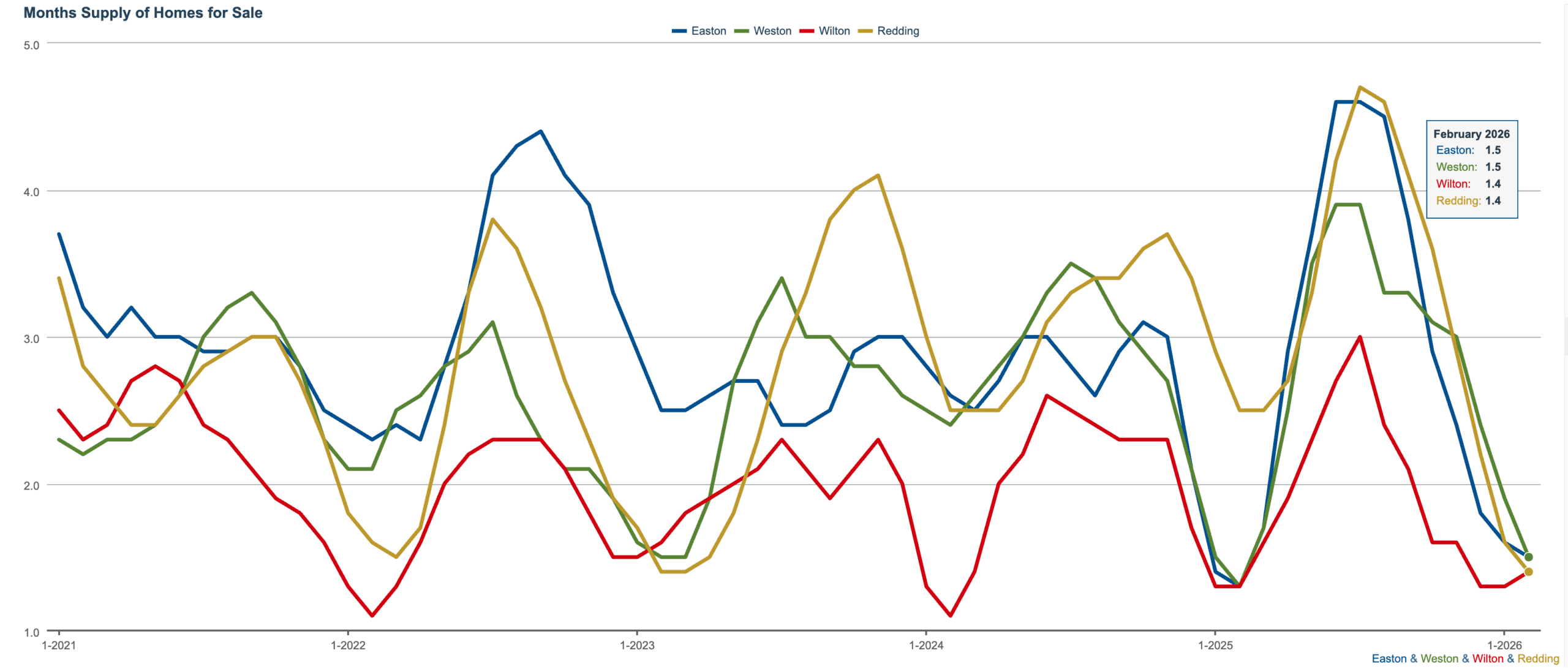
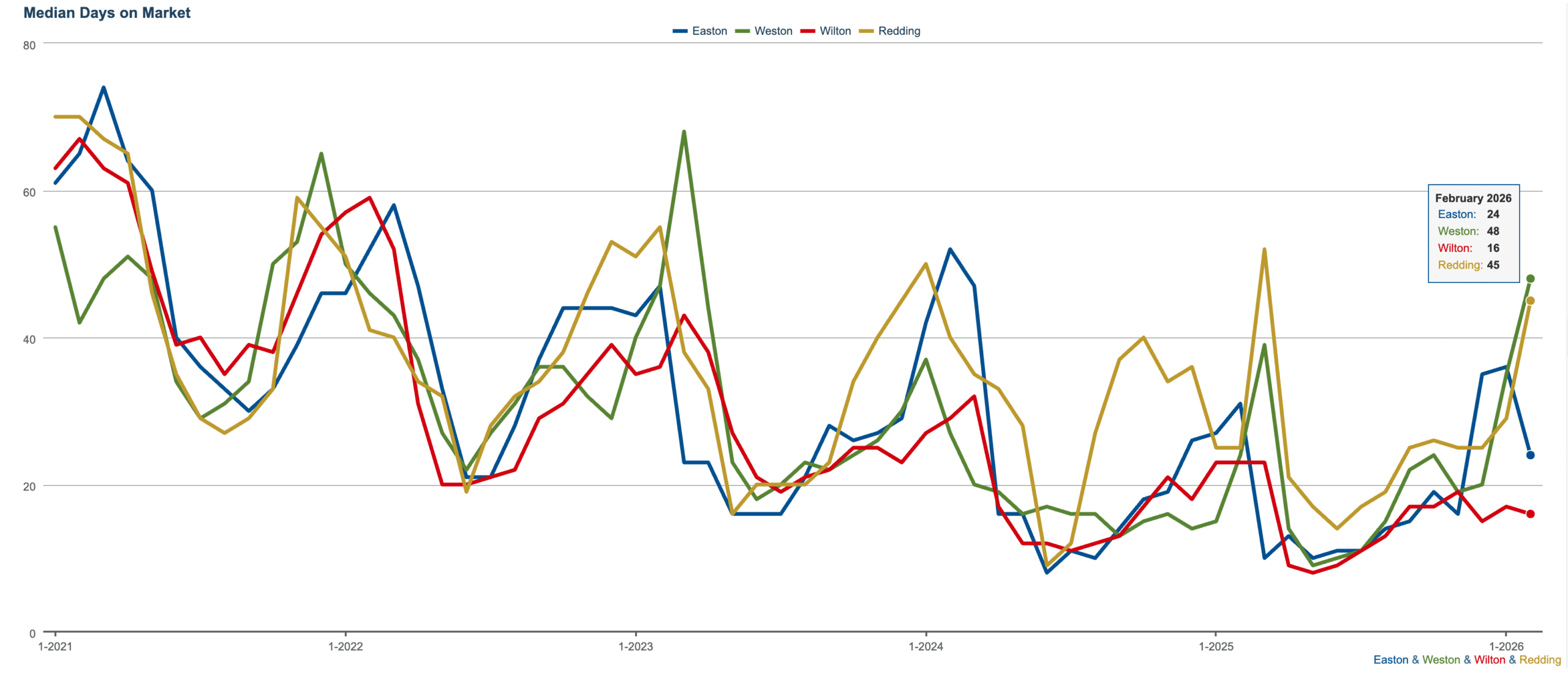
Redding and Weston price differently, and the gap has widened. Weston’s median sale price has held steady in recent years, with price per square foot running approximately $300. Redding trades at a meaningful discount, with lower median prices and price per square foot than surrounding areas. Both towns are rural by design — minimum lot sizes are large, density is intentionally constrained — which means the supply of homes is thin in any given quarter. When a strong property hits in Weston, it moves. Redding moves more slowly, which benefits buyers who can afford patience. For context, Wilton sits between these towns geographically and in price, with meaningfully more inventory. Westport is a different market entirely — medians above $1.7 million — and buyers considering Weston often arrive having been priced out of Westport’s southern neighborhoods. Both Redding and Weston offer genuine value relative to coastal Fairfield County, but they are not interchangeable. If pricing strategy matters to you — and it always does — read through these ten reasons homes fail to sell before you list in either market. Rural inventory demands precise positioning.
COMMUTING REALITIES
Neither Redding nor Weston has a Metro-North station. That is the single most important fact for any commuter to absorb before falling in love with a property in either town. The closest stations are Branchville (a small Redding stop on the Danbury Branch — limited service, no parking to speak of), Cannondale in Wilton, or more practically, Westport or Norwalk on the New Haven Line. From Weston, most commuters drive 15–20 minutes to Westport or Norwalk and board there. Grand Central from Westport runs roughly 70–80 minutes peak. From Redding, the Branchville branch connects to Norwalk and then Grand Central, but service is infrequent — we’re talking a handful of trains per day — and most Redding residents drive to Bethel or Wilton stations instead. By highway, both towns access I-84 via Route 53 or Route 57, and the Merritt Parkway is reachable within 20–25 minutes. This is car-dependent living. Budget accordingly. If daily rail commuting is non-negotiable, Darien or New Canaan will serve you better.
SCHOOLS
Weston’s school system is the primary reason buyers accept the commute penalty. Weston Public Schools — Weston Elementary, Weston Intermediate, Weston Middle School, and Weston High School — consistently rank among the top 10% of Connecticut public schools. The district’s per-pupil spending and student-to-teacher ratios reflect a community that funds education deliberately. The district enrolls approximately 1,900 students across all grades, which means every teacher knows most students by name within a year. Redding feeds into Region 10, which encompasses Redding and Easton and operates Joel Barlow High School. Barlow is a strong school — routinely ranked in the top 20% statewide — but it does not carry Weston’s name recognition among buyers arriving from out of state. Elementary students in Redding attend John Read Middle School and Redding Elementary School. Both systems produce graduates who attend selective colleges. The distinction is perception as much as performance: Weston’s schools are a selling point that appears in every listing; Redding’s schools require explanation to buyers who haven’t done the research.
CHARACTER AND CULTURE
Weston is the more self-conscious of the two towns. It knows what it is — affluent, educated, rural by choice rather than circumstance — and it wears that identity with some pride. The town center is minimal, which is intentional. There are no strip malls. Restaurants are few. The social life is almost entirely private: dinner parties, the school sidelines, the Aspetuck Valley Country Club. It is a town built around domestic life, and buyers who want that find it deeply satisfying. Redding has a quieter self-image. It has fewer resources, a lower median income, and a more heterogeneous housing stock — you’ll find modest ranches alongside significant estates, which you won’t find in Weston. The Mark Twain Library in Redding is a genuine community anchor, and the town has a longer history as an artist’s enclave. If Weston attracts the finance executive who wants privacy, Redding attracts the architect, the writer, the person who found Weston slightly too curated. These are generalizations. But generalizations exist because patterns repeat. If you’re selling a property in either town and wondering whether presentation matters in a rural market, the answer is yes — small improvements before listing move the needle even on a five-acre parcel.
RECREATION AND LAND
Both towns offer exceptional access to land and trails, which is the honest reason people live there. Weston’s Aspetuck Land Trust protects thousands of acres across the region, and the Saugatuck Reservoir — entirely within Weston’s western border — defines the town’s western skyline and feeds the watershed. There is no public swimming there, but kayaking and fly fishing are permitted in designated areas, and the surrounding land provides some of the best trail running in Fairfield County. The Devil’s Den Preserve straddles the Weston-Redding border — 1,756 acres maintained by the Nature Conservancy, with over 20 miles of trails. It is one of the finest preserves in southern New England, full stop. Redding’s Huntington State Park adds another 879 acres of hiking, fishing ponds, and equestrian trails. You can also explore neighborhoods like Devil’s Den, which spans the preserve boundary area and draws buyers specifically for that proximity to protected land. For buyers who came to Fairfield County for the outdoors rather than the shore, this corridor — Weston through Redding into the Housatonic Valley — is the strongest argument in the county. The lifestyle is genuinely rural in a way that Wilton or New Canaan simply cannot replicate, no matter what the listing says about “country feel.” Before closing on a rural property with significant acreage, it’s worth reviewing what seasonal maintenance actually costs on a property like this — the numbers surprise buyers who are accustomed to in-town homes.
WHO BELONGS WHERE
Choose Weston if: your children’s school district is the deciding variable, you want a community of neighbors with similar household profiles, and you’ve made peace with the commute. Weston delivers on those terms consistently. Its resale market is supported by the school district’s reputation in a way that makes the investment rational even at prices above comparables in surrounding towns. Choose Redding if: you want more land for less money, you’re drawn to a slightly less homogeneous community, and the school distinction doesn’t represent a material difference to your family. Redding buyers who understand what they’re buying — and price accordingly when selling — do very well. The mistake is paying Weston prices for Redding land or listing Redding property as if the school narrative matches Weston’s. It doesn’t, and the market will tell you so. If you’re weighing the timing of a purchase or sale in either market, the factors around how long to hold before selling are especially relevant in low-volume rural markets where timing amplifies outcomes.
NEARBY COMMUNITIES
Buyers considering Redding and Weston typically look at a cluster of northern Fairfield County towns simultaneously. Wilton offers stronger train access at Cannondale and a more developed town center while preserving much of the rural character. Norwalk is the nearest coastal city and the most practical commuter hub for both towns, with express trains to Grand Central running under 70 minutes. Westport sits to the south of Weston and represents where many Weston buyers looked first before the price point redirected them north — neighborhoods like Greens Farms and Saugatuck attract buyers who want Westport’s energy with slightly more land. Greenwich and Darien are the coastal anchors of the county — different in character, different in price, and worth understanding as reference points even if you’ve already decided on interior Fairfield County. The market here is specific. Call me if you want a straight answer about where a particular property actually sits in the competitive set.
Properties for Sale
Video

