
Rowayton vs Southport Real Estate
TWO VILLAGES, ONE QUESTION
Buyers who find themselves comparing Rowayton and Southport are asking a version of the same question: which waterfront village fits my life? Both are genuine Connecticut rarities — walkable, architecturally coherent communities built around tidal water, with commuter rail access and top-tier schools within reach. Both command a premium over their host towns and over inland alternatives like Wilton or New Canaan. But they are not interchangeable. Once you understand what each one actually is — geographically, culturally, architecturally — the choice usually makes itself.
THE REAL ESTATE MARKET
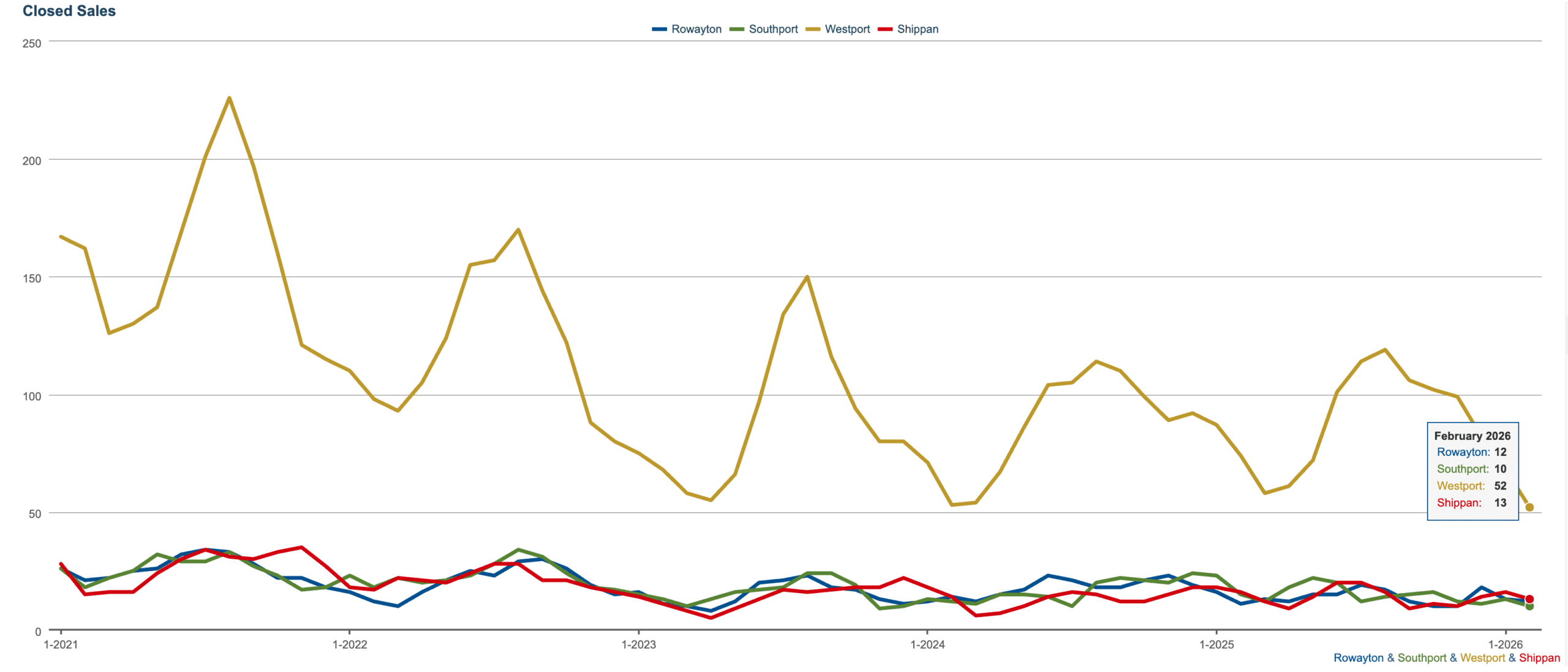
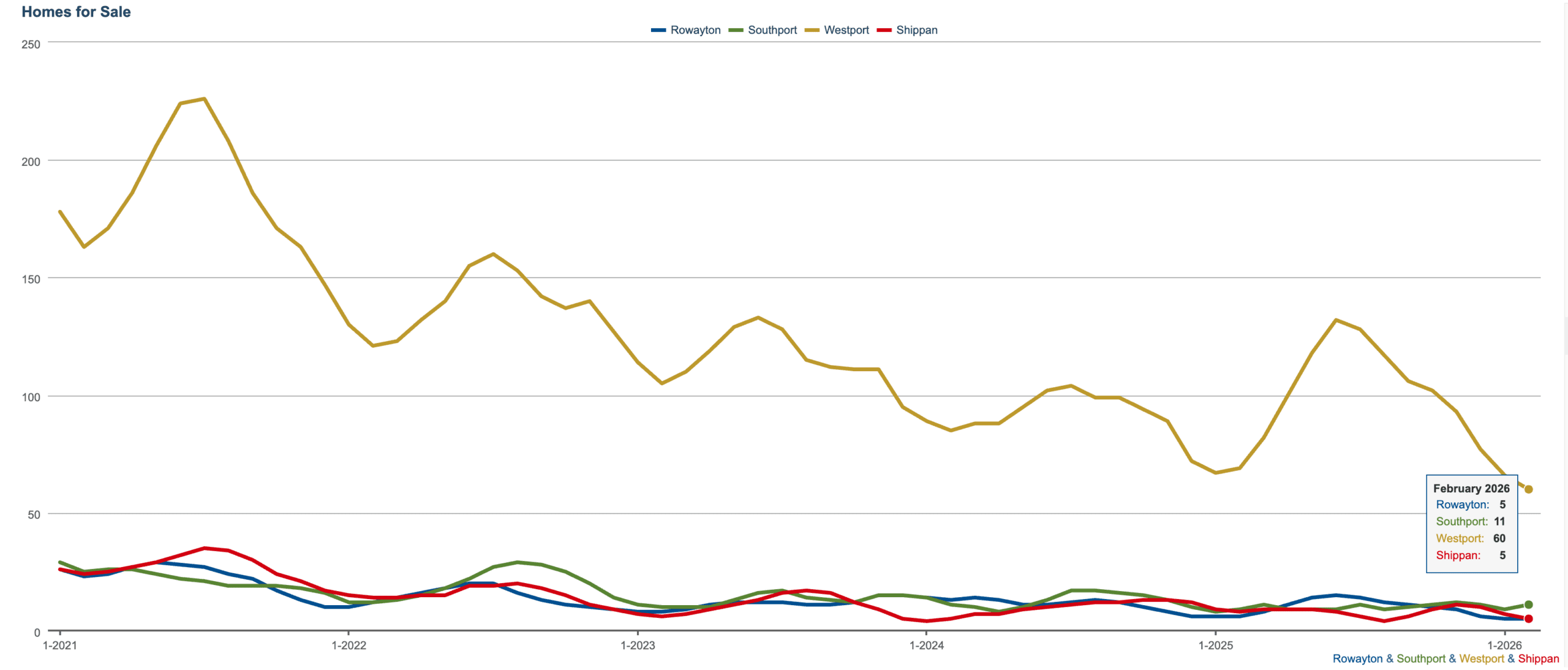
Rowayton is a borough within the city of Norwalk, and that administrative quirk matters financially. You are buying into one of Connecticut’s most sought-after coastal enclaves while paying Norwalk’s mill rate rather than the mill rates of Darien or New Canaan. Rowayton median single-family prices have consistently tracked in a wide range, with waterfront and water-view properties pushing well past that level (RPR, July 2026). Price per square foot runs roughly $500–$650 for non-waterfront homes — meaningfully higher than comparable square footage in inland Norwalk and competitive with Darien on a like-for-like basis. Inventory is structurally tight: the village has fewer than 1,800 households, and turnover is low because residents tend to stay.
Southport is a village within Fairfield, and it carries Fairfield’s mill rate — historically substantially higher than Westport’s, which matters when you are pricing out a $2 million (SmartMLS, September 2026) mortgage. Southport median single-family prices have spanned a wide range in recent years, with harbor-front estates commanding a substantial premium. Price per square foot tends to run $450–$600 for non-waterfront inventory. The village is anchored by the Southport Historic District, which limits tear-down redevelopment and keeps the streetscape intact — a genuine amenity that has real dollar value at resale. If you are evaluating your pricing strategy in either market, understanding why homes fail to sell is as important as understanding what comparable sales show.
COMMUTING TO NEW YORK
Rowayton has its own Metro-North station on the New Haven Line. The express run to Grand Central Terminal takes approximately 55–65 minutes; local trains add ten to fifteen minutes. The station itself sits inside the village, meaning you can walk from many addresses — a genuine differentiator in a commuter market where most Connecticut towns require a drive to the platform. Peak-hour trains run frequently enough that you are not timing your morning around a single departure.
Southport Station, also on the New Haven Line, offers a roughly 60–70 minute express ride to Grand Central. The station is walkable from the village center and from many of the neighborhood’s most desirable streets. I-95 provides a driving alternative for both towns, though peak-hour traffic on the Post Road corridor makes rail the predictable choice for daily commuters. If you are choosing between the two purely on commute time, the difference is negligible — both rank well against inland alternatives.
SCHOOLS
Rowayton children attend Rowayton Elementary School for K–5, then feed into Brien McMahon High School via Norwalk Public Schools. The elementary school earns strong marks and the community is fiercely proud of it, but the Norwalk secondary system is larger and more heterogeneous than Fairfield’s. For buyers with school-age children, this is the most important distinction between the two villages. It is not a reason to rule Rowayton out — many families are entirely satisfied — but it is a reason to visit both systems before you decide.
Southport feeds into Southport School for elementary grades and ultimately into Fairfield Ludlowe High School, which consistently ranks among Connecticut’s top public high schools. Fairfield Public Schools as a system sits in a different tier from Norwalk for secondary performance. If schools are the primary driver of your decision — and for many families they are — Southport’s school funnel is the stronger one.
CHARACTER AND VILLAGE LIFE
Rowayton feels smaller than it is. The Five Mile River cuts through the center of the village, lined with lobster boats, kayaks, and sailboats tied to private docks. The commercial strip along Rowayton Avenue is deliberately low-key — a hardware store, a wine shop, a handful of restaurants — which keeps the village from feeling like a destination for outsiders and preserves the sense that you have found something that does not advertise itself. The architecture is a honest mix of Cape Cods, colonials, and shingled cottages updated over decades. The village association is active; neighbors know each other. It has the social density of a small town without the insularity. When I think about what makes coastal Fairfield County genuinely livable at a human scale, Rowayton is near the top of the list. Thinking about how long you plan to stay matters here — Rowayton rewards buyers who intend to put down roots rather than trade up in three years.
Southport feels like Connecticut from a previous era, and that is not a criticism — it is the product. The Southport Historic District encompasses some of the most photographed streetscapes in the state: Federal and Greek Revival homes on Harbor Road, grand Victorians set back behind stone walls, a harbor filled with wooden sailboats in summer. The commercial area is even smaller than Rowayton’s. Southport is genuinely quiet in a way that appeals to buyers who want to live inside a landscape painting and commute to New York. The trade-off is that the village is less walkable in the practical sense — you will drive to most errands — and the social scene is more diffuse than Rowayton’s concentrated village energy.
RECREATION AND OUTDOORS
Rowayton residents have access to Bayley Beach on Long Island Sound and launch points on the Five Mile River for kayaking, paddleboarding, and sailing. The Rowayton Civic Association manages beach access and community events through the summer. The scale of the village means that outdoor recreation is woven into daily life rather than requiring a drive to a state park. Dog walkers, cyclists, and rowers share the same small streets in a way that feels organic rather than planned.
Southport Harbor is one of the most beautiful small harbors on the Connecticut coast. Southport Harbor supports active sailing and boating communities, and the beach at Penfield Beach in Fairfield is a short drive away. The surrounding area also connects to Fairfield’s trail network and town parks. Buyers who prioritize sailing and harbor access will find Southport’s infrastructure slightly more developed than Rowayton’s.
WHO BELONGS WHERE
Choose Rowayton if you want village life that actually functions as a village — walkable, social, with a station you can reach on foot and neighbors who will know your name within a month. The school calculus is the one honest caution I give buyers, and I give it every time. Choose Rowayton if the elementary school satisfies you and you are prepared to revisit secondary options when the time comes. The Norwalk tax base also means your property tax burden will be structurally lower than in comparable Fairfield County towns. For buyers weighing a move and unsure of timing, our piece on selling during the holidays is worth reading — Rowayton inventory tightens significantly in winter, which occasionally creates buying opportunities.
Choose Southport if the school pipeline to Fairfield Ludlowe is a priority, if you want the most architecturally protected streetscape in lower Fairfield County, and if your version of waterfront living centers on a harbor rather than a river. Southport buyers tend to be slightly less price-sensitive — the Historic District premium is real, and buyers pay it willingly for permanence and beauty. Both villages reward buyers who do their homework. If you are preparing a home in either market for sale, the principles in our guide on weekend projects that move the needle apply directly to the historic and coastal homes that define these neighborhoods.
NEARBY COMMUNITIES
Buyers considering Rowayton and Southport typically also look at Westport, which sits between the two geographically and offers a larger commercial downtown at a higher price point. Darien draws buyers who want the coastal identity without the village footprint — larger lots, a different school system, and a price-per-square-foot premium that has been consistent for a decade. Inland, New Canaan offers more square footage per dollar and arguably the strongest public school system in the county, though you trade the water for wooded hills and a longer commute. Each of these markets has its own logic. The buyers who are happiest are the ones who understood what they were buying — not just what it cost.
Properties for Sale
Video

