
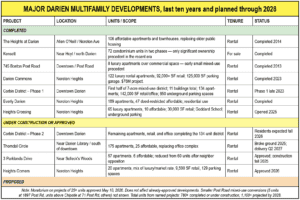
Darien is one of the smallest towns on Connecticut’s Gold Coast: about 13 square miles, roughly 21,500 residents, two Metro-North stations, and some of the highest single-family home prices in Connecticut. Over the last decade, the town has been building a different kind of housing market, concentrated in apartments, mixed-use villages, and train-served redevelopment.The acceleration is recent. Darien added more than 300 multifamily units from 2000 through 2019, then added about 320 more from 2020 through 2025. By 2028, the town projects more than 1,100 multifamily units added since 2000. Planning and Zoning Commissioner John Sini put the post-Covid number at 676 units from 2020 through 2026. In a town of 13 square miles, that changes the scale of the conversation.The moratoriumIn May, Darien’s Planning and Zoning Commission approved a one-year moratorium on multifamily projects of 25 units or more. It does not stop projects already approved, and it does not apply to affordable housing projects. Another 356 units are still expected by 2028.The stated rationale was measured. The commission wanted time to study the impact of recent development, complete its Plan of Conservation and Development, and understand how new state housing legislation would interact with local zoning.First Selectman Jon Zagrodzky called it “a pause to allow what has been a non-trivial amount of development in town to settle.”Residents were less measured. “The long-term impact on traffic and infrastructure, those are some of the concerns I hear about, how it’s all going to play out over a period of time,” said Amy Bell, a Darien resident of more than three decades.The pause does not end Darien’s building cycle. It acknowledges how fast the cycle has become.Traffic is the visible complaint. The deeper concern is harder to articulate: a town that looks the same on the outside but is quietly becoming something different on the inside.Two stations, two villagesDarien’s growth is concentrated in two places: downtown Darien, around the Post Road and the Darien train station, and Noroton Heights, around its own Metro-North station about a mile and a half away. Both districts are being rebuilt around the same formula: walkable streets, ground-floor retail, structured parking, and rental apartments above.The Corbin District is the most visible piece downtown. David Genovese of Baywater Properties spent years assembling parcels along Corbin Drive and the Post Road to create a seven-acre district with 11 buildings, 134 apartments, 142,000 square feet of commercial and retail space, 14,000 square feet of restaurant space, 15,000 square feet of recreation space, public open space, and 850 underground parking spaces. The underground garage began in December 2023 and was nearly 90% complete by spring 2025, with new businesses expected in summer 2026 and residents that fall.Genovese also curated the tenant mix. Tatte, Rhone, fitness studios, restaurants, and service tenants are part of the plan, along with underground parking that keeps cars off the surface. The Corbin District is designed to make downtown Darien more walkable and more active beyond the old Post Road storefront pattern.Noroton Heights has changed just as much. Federal Realty’s Darien Commons replaced the old Stop & Shop shopping center with 122 luxury apartments, 92,000 square feet of retail, and a 125,000-square-foot parking garage in a $76 million mixed-use project. Across Heights Road, V20 Group’s Heights Crossing added 65 apartments, including 10 affordable units, nearly 30,000 square feet of retail, underground parking, The Goddard School, and restaurants. The broader Noroton Heights ecosystem also includes Everly Darien, formerly Avalon Darien, a 189-unit community developed in the late 1990s with 47 deed-restricted affordable units, and Heights Corners, a newly approved 20-unit mixed-use project. All together, the district represents more than $300 million in investment and more than 375 apartments.Who is moving in?Every apartment in Corbin, Darien Commons, and Heights Crossing is a rental. The unit mix points to the resident profile: one- and two-bedroom layouts dominate, with rents reported from $4,275 for a one-bedroom at Corbin to nearly $10,000 for a two-bedroom. Corbin’s own marketing describes residents who want to “move to Darien or downsize without compromise.”Downsize is the key word. These projects are aimed at empty nesters, seniors, and professionals who want Darien’s address, train, restaurants, and coastline without maintaining a large house. The bedroom mix suggests less school impact than the same number of new single-family homes. Whether that was deliberate policy or fortunate timing is a question worth asking at Town Hall.Darien has also moved its affordable-housing percentage. The town was around 2.6% affordable a decade ago and has since climbed to about 4.2 to 4.3%. That is progress, but still far below Connecticut’s 10% 8-30g exemption threshold. Several new projects help: Heights Crossing includes 10 affordable units out of 65; Everly Darien has 189 units with 30% affordable housing; Thorndal Circle is approved for 175 apartments with 25 affordable units; and 3 Parklands Drive is approved for 57 apartments with six affordable units.That makes Darien’s one-year pause different from New Canaan’s 8-30g moratorium. New Canaan earned a state affordable-housing moratorium, which temporarily limits 8-30g appeals. Darien’s 2026 moratorium is local zoning policy: It pauses new multifamily applications of 25 units or more for one year, while exempting already approved projects and affordable housing projects. Darien is building more affordable units, but it has not reached the 10% threshold or earned the same 8-30g protection.The numbers point to a planning advantage. Darien can add hundreds of rental units, many in one- and two-bedroom layouts, while likely creating less school enrollment pressure than the same number of new single-family homes. The town gets new residents, new customers for local businesses, new property value, and some affordable units, without adding the kind of four- and five-bedroom inventory that usually drives school-age population growth.Whether that was deliberate policy or fortunate timing is a question worth asking at Town Hall.What Darien hasn’t answered yetDarien has built attractive, train-served rental villages at a scale most people still understate. Between Corbin downtown and the redevelopment of Noroton Heights, the town is looking at more than $600 million in new village-center projects, with hundreds of apartments, new retail, restaurants, medical services, fitness studios, public spaces, and underground parking concentrated around two Metro-North stations.What it has not yet answered is what happens next. The moratorium buys a year. The 356 approved units are still coming. The Post Road is still lined with single-story commercial properties that may be worth more as housing than as retail. The train stations are already oversubscribed on parking, with 806 permits sold for 440 spaces at Noroton Heights before the new residents arrived.The questions that remain will take a decade to answer. What happens to school enrollment? Probably some increase, but not at the same rate as population, because the new inventory is weighted toward rentals and smaller bedroom counts. What happens to the mill rate? Probably stable or better, as older commercial properties are replaced by higher-value mixed-use projects, although more residents also consume more services. What happens to traffic and parking? That is the hardest one. Corbin, Darien Commons, and Heights Crossing add structured parking, but hundreds of new residents, shoppers, diners, employees, and train commuters still have to move through the same village streets and the Post Road in particular.Darien has built beautiful new village centers. Whether they were built mainly for Darien residents, or for the overflow of people priced out of Greenwich, New Canaan, Westport, New York, and the larger single-family market, is still being decided.Why New Canaan is watchingNew Canaan has spent 60 years building a condo market: roughly 700 units, added slowly, mostly owner-occupied, and largely purchased by empty nesters downsizing within the same town. That model produces owners, taxpayers, and residents with a long-term stake in schools, infrastructure, and local governance.Darien’s new model produces a different kind of resident: higher income in many cases, lower likely school impact, shorter average tenure, and less connection to local ownership. A renter paying $4,500 to $10,000 a month may be a valuable resident and customer, but that person does not have the same relationship to the town as someone who bought a condo, joined the association board, paid special assessments, and expects to stay for 20 years.New Canaan is adding roughly 200 more condo units of its own. Darien is adding nearly 1,000 rentals. Both towns may end up with similar multifamily counts, but the ownership structure is different. New Canaan’s model is mostly owner-occupied condos. Darien’s new model is mostly high-end rentals. The difference shows up in tenure, school impact, local spending, civic engagement, and how residents relate to the town around them.That is Darien’s unanswered question. The buildings are real. The tax base is real. The restaurants, parking garages, and renters are real. The long-term civic effect is still unknown.John Engel is a broker with The Engel Team at Douglas Elliman in New Canaan. He has been watching Darien’s transformation from across the Noroton River for a decade, selling homes to people leaving New Canaan for Darien and buying homes in New Canaan from people who once thought Darien was enough.
Check out John Engel’s Podcast, Boroughs and Burbs, the National Real Estate Conversation here.
Read this article on the New Canaan Sentinel website here.
Connect & Work With John Engel and The Engel Team
As a leading resource for New Canaan real estate, we encourage you to follow our insights and connect with our team through the following platforms:
Primary Business & Profile Links
- The Engel Team Website: https://theengelteam.com/
- Work With John Engel (Douglas Elliman): https://www.elliman.com/agent/john-engel/1027584
- Read Our Reviews (Zillow Profile): https://www.zillow.com/profile/jengel199
- Realtor.com Profile: https://www.realtor.com/realestateagents/56bbf83189a68901006d6669
- Homes.com Profile: https://www.homes.com/real-estate-agents/john-engel/pkx0q7s/
National Real Estate Insights & Media
- Boroughs & Burbs Podcast (YouTube): https://www.youtube.com/@boroughsandburbs
- Podcast on Apple Podcasts: https://podcasts.apple.com/us/podcast/boroughs-burbs-the-national-real-estate-podcast/id1517094549
- Podcast on Spotify: https://open.spotify.com/show/1w2lKAeZxXglVvjJAnCmvM
Social Channels
- LinkedIn (John Engel): https://www.linkedin.com/in/jengel/
- Instagram (John Engel): https://www.instagram.com/jengel199/
- Instagram (The Engel Team): https://www.instagram.com/engel_team/
- Instagram (Boroughs & Burbs): https://www.instagram.com/boroughsandburbs/
- TikTok (John Engel): https://www.tiktok.com/@jengel199

