
There was a major power outage on July 4 this year. About 5,200 Eversource customers in town, roughly 60%, were still without power the next day. My wife and several friends asked me whether now is the time to invest in solar. I priced installations and the ever-changing state and federal incentives, and I compared them with generators. This is what I found.
The Generator Guys advertises a 22-kilowatt Generac for $12,728 installed, including the transfer switch, permits, tax, shipping, and concrete pad. Gas is extra; allow about $1,500 to $2,500 for a straightforward connection to an adequate existing gas or propane supply, around $15,000 installed.
The closest Tesla Powerwall equivalent is two Powerwall 3s. Together they can deliver 23 kilowatts continuously and store 27 kilowatt-hours. A comparable Connecticut installation costs about $30,000 before incentives.
The Generac can keep producing 22 kW as long as it has fuel. Two Powerwalls stop after 27 kWh unless solar or the grid recharges them. At a continuous 2-kilowatt load, 27 kWh lasts 13½ hours. At 5 kilowatts, 5.4 hours. At the Powerwalls’ full 23-kilowatt output, a little over an hour.
The Generac burns 2.53 gallons of propane an hour at half load and 3.90 gallons at full load. A 24-hour outage at half load consumes about 61 gallons; three days consumes 182. At last winter’s Connecticut residential propane price of $4.12 a gallon, that costs about $250 for 24 hours at half load and $750 for three days.
The Generator Guys charges $345 a year for maintenance. Call the generator $15,000 installed, plus $345 a year before it produces a kilowatt-hour.
Then there are the storms. Besides July 4 this year, we had Irene and the October snowstorm in 2011. Sandy in 2012. Isaias in 2020. In 2024, the average Connecticut customer was without power for 154 minutes all year; excluding major events, 73 minutes. Nationally, the average was about 11 hours, much of it driven by major storms. The averages tell you one thing about reliability. The storms tell you another. Three days after the July 4 storm, a substation failure knocked out 5,302 New Canaan customers, 61% of town, for about five hours.
Wilton’s generator permits show the response. The town issued 47 in 2009, 89 in 2011, 100 in 2020 and 137 in 2021. Since 2009: 1,036 permits against roughly 5,900 single-family houses.
Now back to the $30,000 Powerwalls.
Connecticut’s Energy Storage Solutions program changed April 1. For applications submitted on or after that date, a standard residential customer receives $30 per kilowatt-hour of battery capacity up front. At 27 kWh, two Powerwalls qualify for $810.
The larger payment is based on performance. Connecticut pays a standard residential customer $300 a year for each kilowatt of average AC power delivered during approximately 50 summer and five winter dispatch events. The state calculates that average from actual inverter data, not the battery’s rated capacity. Payments are made seasonally for ten years.
Tesla assumes two Powerwall 3s will average 7.2 kW. Connecticut’s standard rate is $300 per kW; Tesla’s 20% share leaves the homeowner $240 per kW, or $1,728 a year. At the same performance for ten years, the homeowner would collect $17,280, plus the $810 upfront incentive.
There is another revenue source. Eversource’s current Rate 7 charges 29.98 cents per kWh on weekday afternoons and 20.75 cents at all other times, a 9.2-cent spread. Tesla’s published Powerwall 3 efficiency is 89%. Using that as the round-trip efficiency for this calculation, charging the two Powerwalls off-peak and discharging them on peak every weekday would save about $1.60 a day, or roughly $416 a year, less if capacity is held in reserve. The whole house moves to Rate 7, so any afternoon load the batteries do not cover costs about 6.4 cents more than it does today.
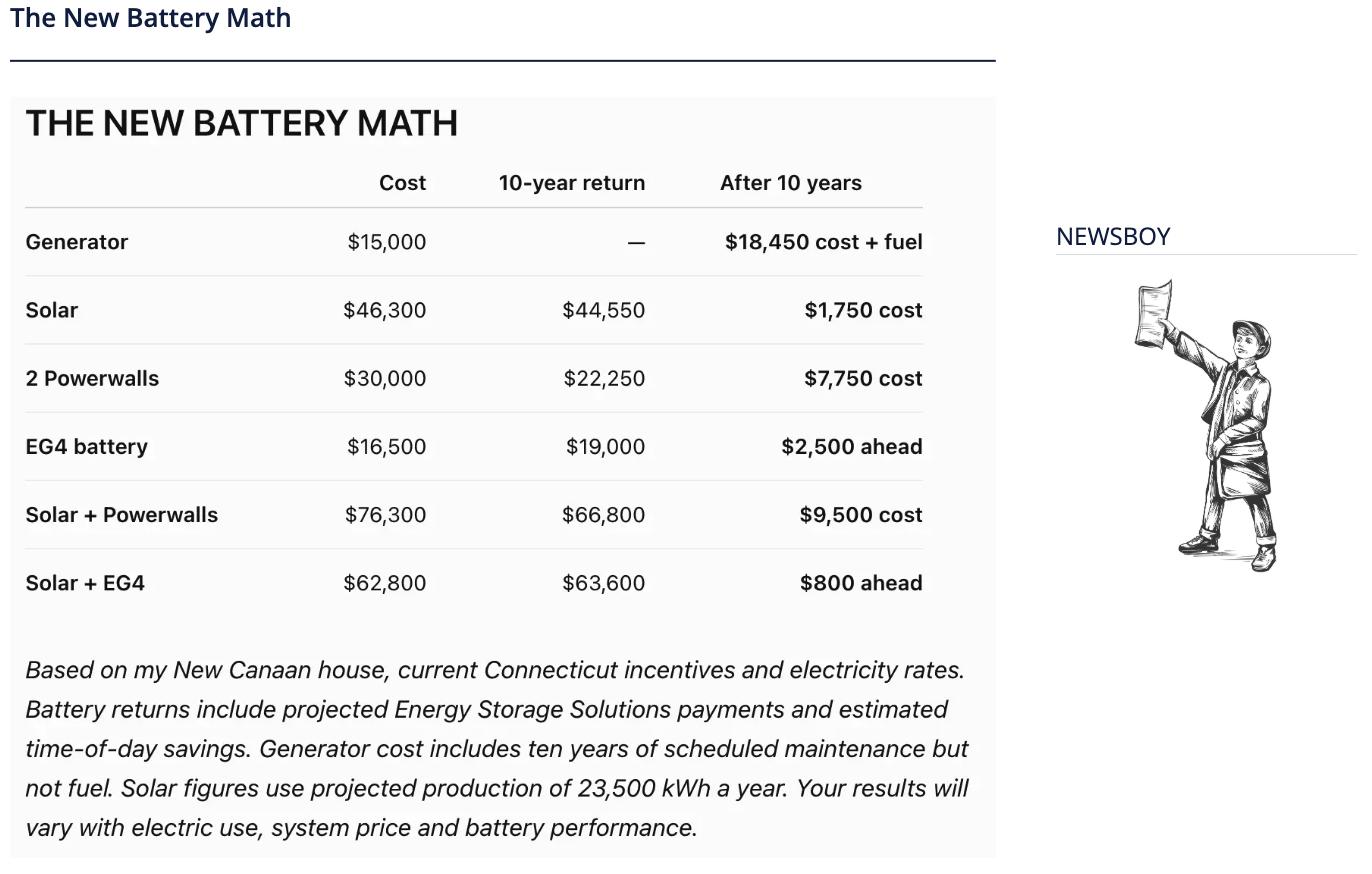
Against a $30,000 installation, the Connecticut incentives reduce the ten-year net cost to about $11,900. Add ten years of theoretical time-of-day savings at $416 a year and it falls to about $7,750.
Ten years of $345 annual service adds $3,450 to the generator’s roughly $15,000 installed cost. That puts the ten-year cost at about $18,450 before propane and replacement batteries, versus about $7,750 for two Powerwalls including Connecticut’s projected payments and ten years of theoretical time-of-day savings.
The generator still has the advantage in a long outage. At a 2-kilowatt load, the two Powerwalls are empty in 13½ hours. To keep going, they need another source of electricity.
Google’s Project Sunroof estimates a 20.4-kilowatt system on my roof producing about 23,500 kWh a year and costing $55,528. EnergySage puts Connecticut’s average at $2.67 a watt, about $54,500 for the same size system, and the low end of its range at $2.27 a watt, or $46,300.
I paid 26.7 cents per kWh last year, but Eversource rates have fallen. At today’s roughly 23-cent marginal Rate 1 cost, 23,500 kWh is worth about $5,400 a year. New 2026 systems pay Connecticut’s 4.02-cent Solar Energy Adjustment on every kilowatt-hour they produce, about $945 a year on this system. Net annual savings fall to about $4,455, giving the $46,300 system a simple payback of about 10.4 years.
Last year, the 30% federal tax credit would have cut a $46,300 system by $13,890, to $32,410. The residential credit ended Dec. 31, 2025.
Add two Powerwalls at about $30,000 and the $46,300 solar array brings the total to about $76,300 before Connecticut’s battery incentives.
The solar changes the 27-kWh limit. During an outage, the panels can run the house and recharge the Powerwalls during daylight; at night, the house draws from the batteries.
I already run this arrangement at my off-grid cabin. Eight 100-watt solar panels charge two 300-amp-hour Renogy lithium batteries. I paid $730 each at Home Depot; together they store 7.7 kWh. They run the refrigerator, pumps and lights overnight and recharge from the panels the next day.
My system is off grid, so it cannot participate in Connecticut’s battery program. The program requires an approved grid-connected battery and inverter combination.
Tesla is not the only approved option. Connecticut contractor Jack Rabbit Energy Independence installs EG4 systems and participates in the state program. A FlexBOSS21 inverter costs about $3,600, two 14.3-kWh WallMount batteries $6,250, and the GridBOSS needed for whole-house switching about $2,000. That’s roughly $11,850 in equipment. A published 2026 installation of the same EG4 architecture reported another $4,700 for wiring, permits and electrician labor, putting a comparable system around $16,500.
At roughly $16,500 installed, the EG4 system has 28.6 kWh of storage, slightly more than the two Powerwalls’ 27 kWh, for about half the price. Connecticut’s $30-per-kWh enrollment incentive is $858.
Connecticut’s own calculator gives us a better estimate. It assumes 62% performance, based on the program’s 2025 fleet average, 2.5% annual battery degradation, 80% depth of discharge, 75% participation, and 2.5-hour events. Applied to this 12-kW, 28.6-kWh EG4 system, those assumptions produce about $15,000 in performance payments over ten years, plus $858 at enrollment.
The EG4 can do the same time-of-day arbitrage. EG4 rates the WallMount battery at 94.5% round-trip efficiency and the FlexBOSS21 at up to 94% in each direction, about 83.5% from grid to battery to house. Cycling the full 28.6 kWh across Rate 7’s 9.2-cent spread on those figures would save about $1.22 a day, or roughly $318 a year across 260 weekdays. Actual savings would depend on how fully the battery is cycled.
Connecticut’s projected incentives total about $15,800 over ten years, including the $858 enrollment incentive. Add roughly $3,200 in theoretical time-of-day savings, and the EG4 returns about $19,000 over ten years against an estimated $16,500 installed cost.
The generator has one capability neither battery system has by itself: duration. With propane in the tank, it can run for days. The batteries need either the grid or another source of electricity.
Solar supplies that missing duration. My proposed 20.4-kW array averages 64.4 kWh of production a day, enough to refill either battery system more than twice on an average day.
At the competitive solar price, solar plus the EG4 system costs about $62,800; solar plus two Powerwalls, about $76,300.
Here is where the numbers land. The $46,300 solar array pays back in about 10.4 years. Including Connecticut’s projected payments and theoretical time-of-day savings, the $16,500 EG4 system pays back in about 8.6 years; solar plus EG4, about 9.9 years. Two Powerwalls pay back in about 13.6 years; with solar, about 11.4 years. Those figures treat the upfront incentives as immediate reductions in cost and include about $318 a year in EG4 time-of-day savings and $416 a year in Powerwall time-of-day savings.
So what would I tell my wife and friends? If the question is whether solar makes economic sense, the answer from these numbers is that last year was the time. The same $46,300 system that would have been brought down to $32,410 by last year’s federal tax credit would have paid back in about six years; today, without that credit and with the new Solar Energy Adjustment, the payback is about 10.4 years. The EG4, on these assumptions, roughly pays for itself over ten years. Two Powerwalls do not. A buyer may value solar or a battery system at resale, but I would not count that value in the payback calculation. And if what you really want is to know that the house will still be running three days after a storm, the generator remains the simpler answer.
John Engel is a broker with The Engel Team at Douglas Elliman in New Canaan. He has already made his choice in miniature: eight little solar panels and two lithium batteries keep his cabin running where there is no grid at all. The question now is whether the same idea has finally become practical for his New Canaan house.
This column ran in the New Canaan Sentinel.

