
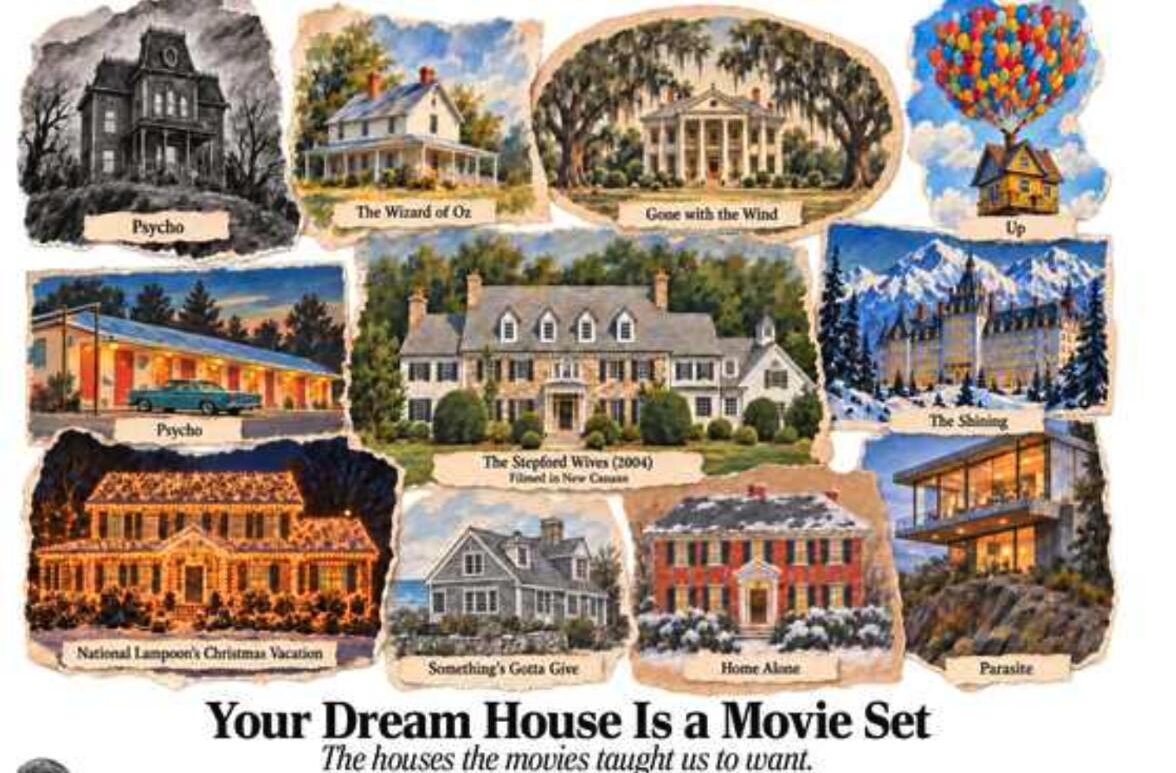
The houses the movies taught us to want.
Ask someone to describe the house they want, and some part of it probably came from a movie: the front staircase from Home Alone, the glass garage from Ferris Bueller’s Day Off, Clark Griswold’s lights from National Lampoon’s Christmas Vacation, or the white kitchen from Something’s Gotta Give. Some of these films concern buying, building, financing, or selling property. In others, a particular house becomes an aspiration, a threat, or the visible expression of a family. Here are my 25 choices for the most memorable uses of houses, homes, and real estate in film, in chronological order:
1. The Wizard of Oz (1939)
A Kansas farmhouse becomes transportation, storm shelter, and murder weapon, carrying Dorothy into Oz and landing on the Wicked Witch of the East. Dorothy then spends the rest of the movie trying to return to the same modest house. Oz is shown in Technicolor and Kansas in sepia, but only one of them is home: “There’s no place like home.”
2. Gone with the Wind (1939)
Tara is Scarlett O’Hara’s inheritance, refuge, and recurring source of strength. She returns from Atlanta to find the plantation damaged, her mother dead, and her family starving. She kills an intruder to defend it and marries Frank Kennedy to obtain the money needed to pay its taxes. The movie ends with Scarlett planning to return to Tara. Its white-columned façade came to represent the plantation South, its grand balls, wealth and enslaved labor, and the destruction of that way of life by the Civil War.
3. It’s a Wonderful Life (1946)
George Bailey’s Building & Loan helps working families leave Potter’s rentals and buy houses in Bailey Park; the Martini family’s move from Potter’s slum is one of George’s proudest achievements. George and Mary make their own home in the abandoned Granville house, where they once threw stones and made wishes. Without George, Bedford Falls becomes Pottersville, a town of Potter’s rentals.
4. Miracle on 34th Street (1947)
Susan’s Christmas wish is the suburban house pictured in a magazine. Kris Kringle directs Susan, her mother Doris, and Doris’s suitor Fred past that exact house with a “For Sale” sign outside. Susan runs in, Fred proposes buying it, and Kris’s cane beside the fireplace suggests that Santa delivered both a house and a family.
5. Mr. Blandings Builds His Dream House (1948)
Cary Grant and Myrna Loy leave their cramped Manhattan apartment for a Connecticut farmhouse, only to learn that the house must be demolished and rebuilt. The plans expand, the bills rise and the dream house nearly overwhelms them. The story was reworked nearly four decades later as the better-known The Money Pit (1986), number 16 on this list.
6. Giant (1956)
Texas rancher Bick Benedict meets Leslie at her family’s gracious Maryland horse farm and brings her to Reata, his vast, isolated ranch house. The contrast measures how far she has traveled. Over three generations, Reata becomes the stage for cattle wealth, oil, inheritance, marriage, and a changing Texas. Also considered: Once Upon a Time in the West (1968), in which Sweetwater’s location and water determine the railroad route and make its owner a target.
7. Psycho (1960)
The dark Victorian house above the Bates Motel appears to watch over the business below. Norman says his mother lives there; her bedroom remains undisturbed, and her body waits in the fruit cellar. Its steep hill, narrow staircase, and silhouetted windows made the Bates house one of cinema’s most recognizable threats. Also considered: Manderley in Rebecca (1940), another house still ruled by the memory of a dead woman.
8. A Raisin in the Sun (1961)
The Younger family shares a cramped South Side apartment until Lena uses her husband’s life-insurance money to buy a house in white Clybourne Park. A neighborhood representative offers to buy them out. Walter’s refusal makes moving into the house an act of ownership, dignity, and resistance.
9. The Swimmer (1968)
Burt Lancaster’s Ned Merrill, from the John Cheever story, decides to swim home through a chain of his neighbors’ pools, which he names the Lucinda River. As he crosses the estates of Fairfield County, each stop reveals another debt, broken relationship, or lost friendship. He finally reaches his own house and finds it dark, deserted, and locked.
10. The Stepford Wives (1975)
Joanna Eberhart leaves New York City for beautiful Stepford, Connecticut, where the houses are immaculate and the wives live only to please their husbands. She discovers that the men are replacing them with obedient replicas. “Stepford wife” became a byword for the sinister perfection concealed inside an ideal suburban home.
11. The Amityville Horror (1979)
The Lutz family buys an impressive Dutch Colonial at an unusually affordable price but soon discovers why: Six members of the previous family were murdered there. Their investment helps explain why they remain after any sensible buyer would flee. The house’s quarter-round windows remain instantly recognizable.
12. The Shining (1980)
The Overlook Hotel, closed for the winter, is the Torrance family’s only home and Jack’s workplace. Its grand public rooms, endless corridors, Room 237, and hedge maze gradually transform isolation into imprisonment.
13. Poltergeist (1982)
The Freelings appear to possess the perfect new house. Then they discover that the developer relocated the cemetery’s headstones but left the bodies beneath the subdivision. Speculative development becomes supernatural horror. In the end, the house folds into itself and disappears.
14. E.T. the Extra-Terrestrial (1982)
Few films make more of the word “home” than this one. E.T. is stranded far from his planet, while Elliott’s own home has been broken by his father’s departure. Elliott shelters him there, helps him contact his family, and finally lets him leave. “E.T. phone home” became the movie’s defining line.
15. A Christmas Story (1983)
The Parker house is the remembered home of childhood: the troublesome furnace, crowded kitchen, leg lamp in the front window, and Christmas tree surrounded by presents. Nothing about it is grand, but Ralphie’s narration turns its ordinary rooms into an idealized American Christmas.
16. The Money Pit (1986)
Walter and Anna believe they have found a distressed mansion at an extraordinary price. The plumbing, wiring, staircase, chimney, and contractors demonstrate that the purchase price is only the beginning of a house’s cost.
17. Beetlejuice (1988)
Adam and Barbara Maitland die on their way home and discover that they must remain in their house for 125 years. The Deetz family buys it, and Delia replaces the Maitlands’ cozy interiors with severe contemporary design. The dead former owners then try to drive out the living new owners.
18. National Lampoon’s Christmas Vacation (1989)
Clark Griswold covers his house with 25,000 lights, brings the extended family under one roof, and commits his expected Christmas bonus to a swimming pool. “Griswold house” is now shorthand for any home whose lights overwhelm the neighborhood.
19. Home Alone (1990)
The red-brick McCallister house is the Christmas ideal, childhood playground, and fortress. Kevin uses its staircase, basement, windows, and rooms to defeat two burglars, but finally wants only his family back inside it. The Winnetka house became one of the most imitated family homes in American movies.
20. Glengarry Glen Ross (1992)
No famous house here. Four desperate salesmen compete to sell lots in Glengarry Highlands and Glen Ross Farms. First prize is a Cadillac, second prize is steak knives, and everyone else is fired. Leads are hoarded, stolen, and manipulated. The film made “Always Be Closing” the most famous sales instruction in real estate.
21. Something’s Gotta Give (2003)
Erica Barry’s Hamptons beach house helped define the modern coastal interior: pale upholstery, blue-and-white fabrics, dark floors, books, and an enormous white kitchen. Few movie houses have had more influence on what homeowners ask designers for. Also considered: Nancy Meyers’s The Holiday (2006), which offered two more fantasies, the small English cottage and the expansive Los Angeles house.
22. Pride & Prejudice (2005)
Beneath this romance is a housing problem. The five Bennet daughters cannot inherit Longbourn; when their father dies, the estate will pass to Mr. Collins. Mrs. Bennet’s frantic matchmaking is therefore about economic survival. Charlotte secures a home by marrying Collins, while Elizabeth refuses him. Bingley rents Netherfield, Darcy owns Pemberley, and seeing how Darcy maintains his estate helps change Elizabeth’s opinion of him. Remove the houses and inheritance law, and much of the plot disappears.
23. Up (2009)
Carl refuses to sell his longtime home to the developers surrounding it. He lifts it into the sky and carries it toward Paradise Falls, eventually recognizing that Ellie’s life with him was not confined to the building. Also considered: Studio Ghibli’s Howl’s Moving Castle (2004), another animated film in which a house travels and becomes home to an unconventional family.
24. The Big Short (2015)
The financing beneath the houses is the subject: weak mortgages, inflated appraisals, securitized debt, and the assumption that American home values could not fall. Investors who recognize the weakness bet against the housing market. 99 Homes (2014), about an evicted Florida father who goes to work for the real-estate operator who took his home, shows the same collapse from the curb.
25. Parasite (2019)
The wealthy Parks live in a modern house above Seoul, while the Kims occupy a cramped semi-basement where the windows look onto the street. A third family lives secretly beneath the Parks. Stairs connect the movie’s three households, turning the building into a map of class and power.
Also considered were Norma Desmond’s mansion in Sunset Boulevard (1950); the disputed property in House of Sand and Fog (2003); the nightmare rental in Pacific Heights (1990); the Thrombey estate in Knives Out (2019); the magical Casita in Encanto (2021); the altered family home in Back to the Future (1985); and the houses of Father of the Bride (1950 and 1991) and Practical Magic (1998).
Three of the 25 are set in Connecticut: Mr. Blandings Builds His Dream House, The Swimmer, and The Stepford Wives. Only the Blandings family ends up happy in their house.
The movies have sold us houses, warned us about houses, and taught us to recognize homes. They gave us the front staircase, the country estate, and the white kitchen. They also put a murderer above the motel, bodies beneath the subdivision, and another family below the basement. Much of what we expect a house to look like, and a home to feel like, we learned at the movies.
John Engel is a broker on the Engel Team at Douglas Elliman. He has lived in 15 homes, including a pool house, a New York City apartment, a German cottage, new construction, and a Revolutionary War-era antique. Each was right for its time.
This column ran in the New Canaan Sentinel on September 24, 2026.

