
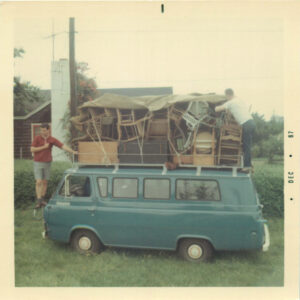
George Carlin had a famous routine about stuff. A house, he said, is just a place to keep it. You leave the house to get more stuff. Then you need a bigger house. Then some of the stuff goes into storage, which means there is an entire industry built around watching your stuff when even your house cannot hold it.
He was joking, but not by much.
For generations, houses like ours were places to keep good stuff.
Brown furniture was not a punchline. It was mahogany, cherry, walnut, breakfronts, dining tables, highboys, secretaries, armoires, four-poster beds, Persian rugs, English chairs, American chests, silver, china, paintings, mirrors, and books. It was what people bought when they were building a life and expected the furniture to last longer than they did.
For the last 20 years, we have been told that our children do not want our stuff. They want experiences. They want flexibility. They do not want dining tables, china cabinets, silver, rugs, and boxes from the attic.
Maybe that is true. Maybe it is changing. Millennials are getting married, having babies, buying houses, and discovering what every generation before them discovered: life accumulates stuff. The question is whether they want our stuff, or whether they want to start the cycle again with their own.
New Canaan used to have stores for that life. Antique shops were a major retail presence in town: The Silk Purse, Severed Ties, Amatulli Imports, Patricia Funt Antiques, Donald Rich, Odesmith & Richards, Sallea Antiques, and others I am forgetting. There were weekend trips to places like United Housewrecking, the great Stamford warehouse of architectural salvage, oddities, indoor and outdoor furniture, garden pieces, old signs, and things nobody needed until they saw them.
My parents and grandparents shopped that way in the 50’s and 70’s. Melissa and I shopped that way as young newlyweds in the 90’s. So did most of our friends. We furnished starter houses one piece at a time, then traded up when we could.
That was the old bargain. Buy well. Keep it. Use it. Pass it down.
As a Realtor, I am asked some version of the same question all the time: what do we do with all of this stuff?
The answer is a three-step process. Keep what is truly sentimental. Sell what has market value. Donate the balance.
That sounds simple until the seller has to decide which category the dining table belongs in. Carlin had a harsher version: nobody wants your fourth-grade arithmetic papers.
Kelly Daniel of Modern Day Auctions (ModernDayBids.com) sees that problem every week. Clients save pieces for children in college or just starting out, assuming they will want them later. Two or three years later, she says, some of those same clients call back and ask her to empty the storage unit and sell everything. The children never came for the furniture. The pieces from a large New Canaan house were the wrong scale for a first apartment, a city rental, or a house in another part of the country. Shipping made no financial sense.
The math can be absurd. In one auction sample, eight Georgian-style mahogany dining chairs that had been purchased for $8,000 sold for $800. After a 35% commission, the seller netted about $520. Store those same chairs for five years at $75 to $100 a month, and the storage bill runs $4,500 to $6,000. That is roughly 9 to 12 times what the chairs brought at auction.
Carlin had a line for that too: “There’s a whole industry based on keeping an eye on your stuff.” In our market, that industry is not just comedy. It is storage units filled with dining tables, rugs, breakfronts, and boxes that nobody has opened in years.
Kelly’s advice is blunt: take a picture, keep the memory, and move on. She says clients rarely regret it once they make the decision. The next generation may keep a few meaningful things, but they do not feel the same obligation to preserve everything just because it belonged to family.
The auction results explain why.
In three recent Fairfield County online auction samples I reviewed, ordinary household contents did not behave like hidden wealth. After removing two cars, the sales produced roughly $96,000 across 417 winning lots. That is an average of about $231 per lot before commission.
The median was lower. In the three sales, the median winning bid fell between $75 and $132.50. After a 35% commission, net was roughly $49 to $86 to the seller.
The paid-versus-sold examples are more useful than the averages. A vintage English mahogany breakfront, purchased for $7,000, sold for $50. A Hancock & Moore leather chair and ottoman, purchased for $6,645, sold for $310. An antique Persian Sarouk carpet, purchased for $16,750, sold for $1,089. Eight Georgian-style mahogany dining chairs, purchased for $8,000, sold for $800. An English crotch mahogany dining table, purchased for $5,175, sold for $1,350.
Some things still have a market. Cars, outdoor furniture, gym equipment, unusual objects, art, books, rugs, sterling, porcelain, and recognizable designer or collector categories can still surprise you. Large formal furniture often does not.
Kelly says online auctions have widened the reach. When she ran traditional estate sales, a few hundred people might come through the house, many of them browsing as an activity. Online auctions can bring thousands of bidders, including national and international buyers. Her sell-through rate is about 99%, and gross sales are 30% to 40% higher than what she saw in traditional estate sales.
That is the best-case version of the modern contents market: more bidders, broader reach, higher gross sales.
And still, the median lot can be $75.
The financial scale is bracing when you compare the contents to the house. A $20,000 contents auction at a 35% commission nets $13,000. On a $5 million house, that is 0.26% of the sale price. On a $7 million house, it is 0.19%.
This is one of the frustrations of the job. Sellers push back because the furniture still feels like part of the house. It has cost, quality, memory, and place. The dining table belongs in that dining room. The breakfront belongs on that wall. The rug was bought for that room. But once the house goes to market, the contents are no longer part of the house’s value. They are a separate problem with a much smaller price tag.
Sometimes the furniture helps. In the sale of my own house 20 years ago, I remember that including furniture helped bridge a gap. I have seen the same thing in $4 million and $6 million sales where the owner needed to feel that a number was met, and furniture became part of the solution.
Other times, it gets in the way.
In one recent $7 million sale, buyer and seller had agreed on price until the buyer insisted on including furniture, art, and antiques headed to auction. The furniture became the fight. A second buyer flew in, gazumped the offer with a cleaner full-price contract, and got the house.
Many New Canaan residents eventually discover that New Canaan stuff does not always fit the next house. It may be Florida, Texas, California, the Carolinas, a city apartment, a smaller condo, or assisted living. Brown, formal Connecticut furniture can feel wrong in a lighter, lower, more casual house, or in a place where every inch has to work. My aunt may be the exception. She recreated her entire condo inside Edge Hill (assisted living). Most people do not.
Kelly’s practical advice is simple. Pick the pieces you truly love. Be realistic about size, scale, and moving costs. If family members want pieces, wonderful. Just do not rely on that as the plan.
The online world has made de-accessioning both easier and harder. There may be a buyer somewhere for almost anything. eBay, Facebook Marketplace, online estate auctions, collector forums, and specialist dealers have made the market larger than it has ever been. Every obscure object can be researched, compared, listed, watched, bid on, and shipped.
The hard part is accepting the clearing price.
My parents had the right idea. Every Christmas, they would offer my sister and me, and our spouses, any object in the house. Take it off the wall and bring it home with you, they would say.
It was funny at first. Then it became wise.
They knew their favorite objects were going to homes where they would be appreciated. I have the Biedermeier clock they bought on their honeymoon for 15 marks. My sister has the antique globe that dates from our earliest collective memories. Neither object has much practical use today. Neither would likely bring much on eBay. Both are where they belong.
In their final decade of collecting, my parents dribbled out the best 50 pieces from a lifetime of looking, buying, remembering, and keeping. They placed the pieces themselves.
Carlin was right. A house is a place for your stuff. But when the house sells, the stuff has to go somewhere.
The lucky pieces go to people who want them.
The rest go to auction.
John Engel is a broker on The Engel Team at Douglas Elliman in New Canaan, and he loves a parade. Last week New Canaan celebrated 250 years with a parade and John escorted 99-year old Janet Karl in John Barker’s yellow Corvette. Mrs. Karl started life as a Bounton and is 3rd-generation New Canaan. Mrs. Karl and husband Dick ran Karl Buick (& Saab) at what we know as McKenzies on South Avenue, and later next to Leo’s Karl Chevrolet. American muscle, indeed.
Check out John Engel’s Podcast, Boroughs and Burbs, the National Real Estate Conversation here.
Read this article on the New Canaan Sentinel website here.
Connect & Work With John Engel and The Engel Team
As a leading resource for New Canaan real estate, we encourage you to follow our insights and connect with our team through the following platforms:
Primary Business & Profile Links
- The Engel Team Website: https://theengelteam.com/
- Work With John Engel (Douglas Elliman): https://www.elliman.com/agent/john-engel/1027584
- Read Our Reviews (Zillow Profile): https://www.zillow.com/profile/jengel199
- Realtor.com Profile: https://www.realtor.com/realestateagents/56bbf83189a68901006d6669
- Homes.com Profile: https://www.homes.com/real-estate-agents/john-engel/pkx0q7s/
National Real Estate Insights & Media
- Boroughs & Burbs Podcast (YouTube): https://www.youtube.com/@boroughsandburbs
- Podcast on Apple Podcasts: https://podcasts.apple.com/us/podcast/boroughs-burbs-the-national-real-estate-podcast/id1517094549
- Podcast on Spotify: https://open.spotify.com/show/1w2lKAeZxXglVvjJAnCmvM
Social Channels
- LinkedIn (John Engel): https://www.linkedin.com/in/jengel/
- Instagram (John Engel): https://www.instagram.com/jengel199/
- Instagram (The Engel Team): https://www.instagram.com/engel_team/
- Instagram (Boroughs & Burbs): https://www.instagram.com/boroughsandburbs/
- TikTok (John Engel): https://www.tiktok.com/@jengel199

