
The New Canaan Beautification League is coming Thursday to look at my meadow. That timing is useful because it forces me to explain what they are coming to see.
It is not a finished meadow. It is not even yet a conventionally beautiful meadow. It is Year One of what I expect to be a three-year restoration. A year ago, the meadow was largely a monoculture of invasive Japanese stiltgrass. My first plan was simple: string-trim invasives each August for three years to keep the stiltgrass from setting seed. I scattered several pounds of native seed. Some stiltgrass is still there, but it is being crowded out by goldenrod and asters.
The Beautification League’s visit also gives me a chance to make a correction. My Instagram video on their Lee Garden drew 15,000 views, proof that people care about that hidden garden. But in the video, I failed to credit the League, which maintains it, along with the traffic triangles, seasonal plantings, holiday greens and downtown hanging baskets many residents see every day.
Lee Garden is a mature spring garden, begun in 1940, and carried forward by the Beautification League since George Lee left it to the organization in 1978. It peaks in May, when the azaleas and rhododendrons are at their best. Wooded, rocky, shaded, and layered, it is beautiful because people understood what it was and kept caring for it for more than 80 years.
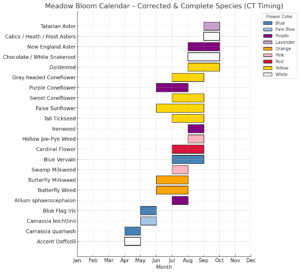
My meadow has a different ambition: succession. Camassia and blue flag iris in spring; swamp milkweed, blue vervain, cardinal flower, and coneflowers in summer; Joe-Pye weed, ironweed, goldenrod, snakeroot, and asters into fall. That is why the bloom calendar matters. It shows a landscape designed not for one moment, but for three seasons of color, food, and habitat — and for butterflies, dragonflies, fireflies, birds, and all the smaller life that makes the system work.
A meadow is not an unmowed lawn. It is not a packet of wildflower seed scattered over grass. It is not neglect with better public relations. A meadow is an open plant community, managed so that it does not become brush and then woods. It has to be edited. It has to be watched. It has to be allowed to change without being allowed to disappear.
A meadow is a maintained refusal to poison the land.
That sentence is mine, but the idea comes largely from Bill McDonald. Bill and Mary-Ellen McDonald have created what many New Canaanites now know as the Firefly Meadow. Bill has taught me that a meadow is not just a planting scheme. It is a system. His central lesson is simple: The meadow succeeds because he does not use chemicals and the water is pure. No fertilizer. No herbicide. No pesticide. Clean water. Darkness. Wet edges. Leaf litter. Trees nearby. Insects, slugs, snails, worms, and a functioning food chain.
That is one kind of meadow.
Hannan-Eberstadt Field, at Canoe Hill Road and Route 123, is another. Right now, it is full of orange butterfly weed. That is the most legible kind of pollinator meadow. It announces itself from the road in the easiest possible language: color, sun, summer, butterflies.
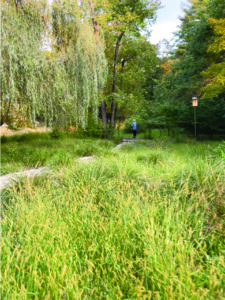
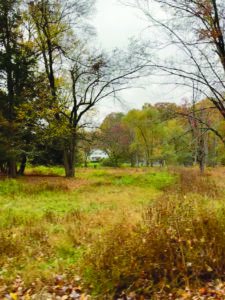
My meadow is different again. Mine is a wet meadow. You’ll sink to your ankles in some places.
First, a note about the property. The house is 225 years old and was Elise Lapham’s from 1950 until 1995. We have been told the entrance drive, with its graceful curve around the meadow, was designed by the Olmsted firm, the same firm that helped lay out Waveny for the Lapham family. The drive does not ignore the meadow. It circles it. The open space is part of the arrival.
Water shapes the property. A stream enters beneath the road at the front, moves through the meadow, and continues below Ponus Ridge toward the Noroton River. The pond holds blue flag iris, Dutch iris, and water lilies. Along the house, road, and stone walls are thousands of crocuses, daffodils, daylilies, and peonies, with tulips, potatoes, and tomatoes tucked where I hope the deer will not venture. On the dry hill north of the house are more daffodils, alliums, and butterfly weed for monarchs. Along the driveway and woodland path are New York fern, cinnamon fern, sensitive fern, royal fern, Christmas fern, and other native ferns I am still learning.
In the meadow, the long-term goal is not simply a field of flowers. It is a functioning native plant community that provides nectar, pollen, seeds, cover, and habitat across the growing season while gradually displacing stiltgrass without herbicide use.
Visitors will see roughly two dozen wire cylinders. Each marks a planting location containing Camassia bulbs, both common camas and great camas, for early spring bloom. The cages were also meant to protect cardinal flower from deer. The cardinal flower has been slower to appear than I hoped, but I am seeing asters, blue vervain, snakeroot, goldenrod, milkweed, and other native seedlings beginning to claim space.
At this stage, the meadow is more interesting botanically than visually. That brings me to the real estate problem.
A lawn is easy to understand. It is green. It is mowed. It asks little of the imagination. A meadow asks more. In July, it may look alive. In November, it may look brown and spent. In its first years, it may look thin, uneven, or unfinished. The owner may see milkweed, sedges, vervain, asters, future monarchs, and future fireflies. A buyer may see weeds.
The value of a meadow depends on whether it reads as intention or neglect.
That, I think, is the broader shift in New Canaan. In a year when the Town Council debated leaf blowers, the question of how we maintain our properties is front and center. For generations, the ideal landscape was control: lawn, edging, foundation shrubs, fertilizer, herbicide, irrigation, and weekly mowing. That kind of landscape can still be beautiful. I am not against lawns. Lawns are useful. Children play on them. Dogs run on them. Houses often need some open green around them.
But the definition of a good landscape is changing. The Beautification League, the Garden Club, the Land Trust, Pollinator Pathway, the Bristow Bird Sanctuary restoration, and private landowners are all part of that change. The new vocabulary includes native plants, habitat, invasives, watershed, dark skies, pollinators, meadow management, and chemical-free maintenance.
Elise Lapham understood part of that long before the current language took hold. She helped found the New Canaan Land Conservation Trust, along with Jack Gunther and Mary-Lib Katzenbach. That matters to me because the same woman who once lived in my house helped build one of the institutions that still protects open space in town. The work continues today through Land Trust stewards who maintain trails, remove invasives, restore habitat, and make open space visible and usable. Bristow’s recent restoration is part of the same story.
Which brings me back to real estate.
Does landscaping add value? Yes, but not in the simple way sellers often want. Landscaping is not a kitchen, a bath, a roof, or a boiler. Those improvements are easier to photograph, price, and compare. Landscaping is more elusive. It changes by season. It can be immature, mature or past its prime. It can look like paradise to one buyer and maintenance to another.
Curb appeal matters. A property that looks cared for feels less risky. Mature trees, screening, paths, stone walls, gardens, terraces, and outdoor rooms can all change how a buyer experiences a house. But landscape value is not just a question of how much was spent. It is a question of interpretation.
Landscaping adds value when it makes land legible.
That is what I have learned from the meadow. The more I know, the more I see. What once looked like weeds now separates into natives and invasives, spring bloomers and fall bloomers, host plants and nectar plants, wetland plants and dry-hill plants. Land becomes more valuable when it becomes more understandable.
That is also true of acreage. In New Canaan, more land does not always mean proportionally more value. One acre close to town, two acres farther out, and four acres farther still can sometimes produce surprisingly similar values. Convenience declines as you move away from town. Privacy, quiet, and the perception of open space increase. Acreage is quantity. Landscape is meaning.
The best landscapes explain the land. They show where the water moves. They frame the house. They create arrival. They reveal stone walls, old trees, shade, sun, paths, wet places, and dry places. They make a property feel inevitable.
That is what I hope my meadow will eventually do.
It is not there yet. It has cages, stiltgrass, too little bloom now and, I hope, much more bloom later. It is not Lee Garden in May, Bill McDonald’s mature Firefly Meadow, or Hannan Field blazing orange from the road.
It is a wet meadow at the beginning of becoming itself.
The Beautification League may come Thursday and see more work than beauty. That is fair. But if they look closely, I hope they will see intention: spring bulbs, wetland plants, native seed, protected cages, emerging colonies, clean water, no chemicals, and a three-season plan.
The value of a meadow is not that it looks wild. The value is that, with time and care, it makes the land feel alive.
John Engel is a broker on the Engel Team at Douglas Elliman in New Canaan. He is learning that a meadow, like a museum, is better with labels. The experience changes when you know what you are looking at. A painting is more powerful when you understand the artist, the period, the subject, and the technique. A meadow works the same way. What once looked to John like weeds now separates into natives and invasives, spring bloomers and fall bloomers, host plants and nectar plants, wetland plants, and dry-hill plants. Apps like PictureThis and Pl@ntNet have become field guides in his pocket. Merlin Bird ID does the same for sound, separating a Barred Owl from a Great Horned Owl in the dark. The more he knows, the more he sees.
Check out John Engel’s Podcast, Boroughs and Burbs, the National Real Estate Conversation here.
Read this article on the New Canaan Sentinel website here.
Connect & Work With John Engel and The Engel Team
As a leading resource for New Canaan real estate, we encourage you to follow our insights and connect with our team through the following platforms:
Primary Business & Profile Links
- The Engel Team Website: https://theengelteam.com/
- Work With John Engel (Douglas Elliman): https://www.elliman.com/agent/john-engel/1027584
- Read Our Reviews (Zillow Profile): https://www.zillow.com/profile/jengel199
- Realtor.com Profile: https://www.realtor.com/realestateagents/56bbf83189a68901006d6669
- Homes.com Profile: https://www.homes.com/real-estate-agents/john-engel/pkx0q7s/
National Real Estate Insights & Media
- Boroughs & Burbs Podcast (YouTube): https://www.youtube.com/@boroughsandburbs
- Podcast on Apple Podcasts: https://podcasts.apple.com/us/podcast/boroughs-burbs-the-national-real-estate-podcast/id1517094549
- Podcast on Spotify: https://open.spotify.com/show/1w2lKAeZxXglVvjJAnCmvM
Social Channels
- LinkedIn (John Engel): https://www.linkedin.com/in/jengel/
- Instagram (John Engel): https://www.instagram.com/jengel199/
- Instagram (The Engel Team): https://www.instagram.com/engel_team/
- Instagram (Boroughs & Burbs): https://www.instagram.com/boroughsandburbs/
- TikTok (John Engel): https://www.tiktok.com/@jengel199

