
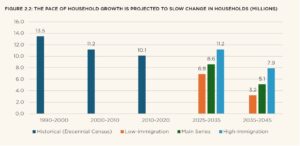
For more than a decade, the housing argument has been simple. America did not build enough homes. Millennials formed households faster than builders supplied them. Inventory fell, prices rose and the solution appeared obvious: build more.
A new white paper from the Mortgage Bankers Association (MBA) asks whether that explanation is approaching its expiration date.
The authors argue that housing demand will grow much more slowly during the next two decades. Generation Z is smaller than the Millennial generation. Birth rates are down. Immigration may slow. The population is aging. Household formation, the basic engine of housing demand, is expected to decelerate.
At the same time, builders are still delivering homes and apartments conceived when demand looked stronger. Older homeowners will gradually release additional houses into the market. The paper concludes that housing supply could eventually grow faster than demand, producing falling prices in some parts of the country.
That is a startling conclusion after years of hearing that the United States is short somewhere between 1.5 million and 7.3 million homes.
It is also a reminder of how imprecise the national shortage argument has always been. A range of nearly six million homes is too broad to guide a town deciding how much housing to approve, what kind to build, or whom it should serve.
The more important question for us is whether the national forecast applies to lower Fairfield County.
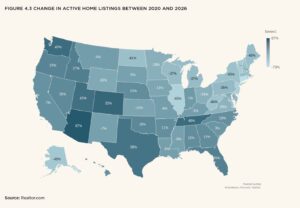
Our market does not look like Austin, Phoenix, or Tampa, where subdivisions and apartment developments can add thousands of units in a few years. Connecticut is one of the hardest and most expensive places in the country to build. Realtor.com recently ranked it 46th among the 50 states and Washington, D.C., when affordability and new construction were considered together.
Over roughly the past fifteen years, Stamford, Norwalk, and Darien have completed an estimated 11,000 to 12,000 apartments. Including projects under construction, approved, or in the active pipeline, the total approaches 16,000: roughly 10,000 in Stamford, 5,000 in Norwalk and 1,100 in Darien. Greenwich issued permits for roughly 1,450 housing units from 2011 through 2023. After demolitions, state estimates show a net increase of about 600 units. The town now has 120 apartments under construction and roughly 900 more units approved. The large projects in the four-town pipeline are overwhelmingly multifamily or attached housing. Detached-house supply remains constrained by land, zoning, and the fixed number of residential lots. Tear-downs replace existing houses without adding lots.
Demand is harder to measure.
The MBA paper estimates demand by studying fertility, immigration, aging, and household formation. Those are reasonable national measures. But lower Fairfield County is not a closed demographic system.
Our buyers do not come only from the children born here 30 years ago. They come from Manhattan and Brooklyn and elsewhere. They move for schools, space, safety, jobs, and taxes. Some arrive with incomes and equity accumulated in a much more expensive market. Hybrid work increased the distance many people are willing to live from the office.
Our demand therefore depends partly on what happens in New York City. A strong financial sector, high compensation, rising Manhattan apartment prices, or dissatisfaction with city schools can produce Fairfield County demand that Connecticut’s population statistics would never predict.
The reverse is also true. A weaker New York economy, reduced bonuses, fewer commuting days, or a loss of high-paying jobs could affect us more quickly than a national decline in household formation.
Then there is affordability.
Scarcity supports prices, but scarcity cannot make buyers richer.
National home prices rose 55% from 2020 through 2025, leaving housing expensive relative to income. Income growth has recently begun to catch up in many markets, although buying remains far more expensive than renting. Connecticut adds to that burden with high property taxes, expensive insurance and maintenance, and some of the costliest electricity in the country. Those costs are still climbing. Eversource is seeking a rate increase of 11% to 18%, and the end of the federal solar tax credit on Jan. 1, weakening the main hedge homeowners had against it.
These expenses do not necessarily cause house prices to collapse. They reduce the number of households able or willing to carry an expensive property. The same economics that stall approved projects in Greenwich confront every buyer at the closing table.
All that creates the possibility of a market with too few houses and too few qualified buyers.
The result would not look like the overbuilt Sun Belt. We would be unlikely to see rows of unsold new houses. We might instead see very low inventory, fewer transactions, longer marketing times for compromised properties, and continued competition for the best houses.
Price would depend increasingly on location, condition, and carrying cost. The renovated house near the train might attract several buyers. The oversized house with high taxes, an aging roof, and expensive mechanical systems might sit, even when little else is available.
The predicted “silver tsunami” is also unlikely to flood our market. Older homeowners are remaining in their houses longer. When those homes are eventually sold, many will require significant renovation and may still be unaffordable to the younger households expected to replace their owners.
The MBA paper does not prove that Fairfield County’s housing shortage is ending. It shows why we should stop treating housing demand as permanent and unlimited. Our limited land and resistance to construction will continue to restrict supply, while high taxes, energy costs, and mortgage payments restrict demand.
For lower Fairfield County, the outcome will depend on whether demand generated by New York City continues to outrun the combined burden of high prices, property taxes, insurance, electricity, and maintenance.

Readers who would like a copy of the 26-page MBA report can e-mail me.
John Engel is a broker leading The Engel Team at Douglas Elliman in Connecticut. Today, his daughter, Rose, dances with the Thomas Ortiz Dance Company at Weed Beach in Darien, one of eight free ballet performances across Fairfield County this summer. Along with Shakespeare in Rowayton’s Pinkney Park and the Wednesday concerts on New Canaan’s Waveny lawn, it is a reminder that some of the best parts of summer still happen live, outdoors, and free. After a column full of statistics and projections, ballet by the water feels beautifully analog. Admission is free, the supply is limited, and demand should be strong. (thomasortizdance.org)
Check out John Engel’s Podcast, Boroughs and Burbs, the National Real Estate Conversation here.
Read this article on the New Canaan Sentinel website here.
Connect & Work With John Engel and The Engel Team
As a leading resource for New Canaan real estate, we encourage you to follow our insights and connect with our team through the following platforms:
Primary Business & Profile Links
- The Engel Team Website: https://theengelteam.com/
- Work With John Engel (Douglas Elliman): https://www.elliman.com/agent/john-engel/1027584
- Read Our Reviews (Zillow Profile): https://www.zillow.com/profile/jengel199
- Realtor.com Profile: https://www.realtor.com/realestateagents/56bbf83189a68901006d6669
- Homes.com Profile: https://www.homes.com/real-estate-agents/john-engel/pkx0q7s/
National Real Estate Insights & Media
- Boroughs & Burbs Podcast (YouTube): https://www.youtube.com/@boroughsandburbs
- Podcast on Apple Podcasts: https://podcasts.apple.com/us/podcast/boroughs-burbs-the-national-real-estate-podcast/id1517094549
- Podcast on Spotify: https://open.spotify.com/show/1w2lKAeZxXglVvjJAnCmvM
Social Channels
- LinkedIn (John Engel): https://www.linkedin.com/in/jengel/
- Instagram (John Engel): https://www.instagram.com/jengel199/
- Instagram (The Engel Team): https://www.instagram.com/engel_team/
- Instagram (Boroughs & Burbs): https://www.instagram.com/boroughsandburbs/
- TikTok (John Engel): https://www.tiktok.com/@jengel199

