
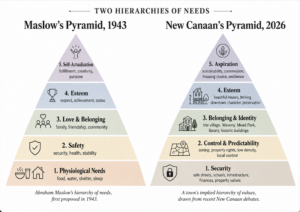
Abraham Maslow was an American psychologist who, in 1943, proposed a theory of human motivation that became known as the hierarchy of needs. The familiar version starts with basic physiological needs, then safety, belonging, esteem and, finally, self-actualization — the point at which we can concern ourselves with becoming the best version of ourselves.
So what would Maslow’s hierarchy look like if he were writing about New Canaan?
At the base: Security.
Safe streets. Good schools. Reliable infrastructure. Police, fire, roads, sewers. Sound finances. Stable property values. The basic promise that if you buy a house here, the schools will remain strong, the roads will be maintained, emergency services will show up, the town will manage its finances responsibly, and the rules governing your property and neighborhood will not change unpredictably.
Next: Control and predictability.
Zoning. Property rights. Low density. Fiscal restraint. Local control. A feeling that change happens deliberately and that residents have some ability to influence what happens beside their house, on their street and in their town.
Perhaps the greatest threat to that sense of control has been Connecticut’s 8-30g affordable housing law. For towns like New Canaan, it can sharply limit the discretion traditionally exercised by local Planning & Zoning commissions and shift critical land-use decisions into the courts.
That concern is especially acute in New Canaan, where zoning has shaped the town for generations. Lot size, density, setbacks and permitted uses are not abstract planning concepts; they help determine what our neighborhoods look like, how they feel and, ultimately, what our homes are worth.
Then: Belonging and identity.
Elm Street and the village center. Waveny House and the park around it. Christmas Eve caroling at God’s Acre. The New Canaan Library. The Rams. The places, institutions and rituals through which generations of residents have come to recognize New Canaan as home.
Waveny is more than a park. The former Lapham estate, its mansion and landscape became part of the town’s shared life. God’s Acre is more than open space when families have gathered there on Christmas Eve for generations. The Library has occupied a place in the center of community life since the nineteenth century. These are places where belonging accumulates over time.
Our Plan of Conservation and Development tries to put some of that identity into words. Every ten years, by state law, we rewrite the POCD, but in New Canaan we treat it as considerably more than a statutory exercise. We quote it in land-use debates. We invoke it when development is proposed. We use it to describe both what New Canaan is and what we want it to remain.
The current plan talks about preserving community character, nurturing downtown, housing, conservation, sustainability, infrastructure and the natural environment. In other words, it tries to describe the town we recognize and the qualities we are trying to carry forward.
Then comes Esteem.
Philip Johnson’s Glass House. The Harvard Five and the modern houses that made New Canaan an international architectural destination. SANAA’s River Building at Grace Farms. Excellent schools. A downtown that remains active and walkable. Public spaces and civic buildings that residents expect to be exceptionally well designed and maintained.
Esteem is the pride we take in New Canaan and the reputation the town has beyond its borders. People travel here to see the Glass House and Grace Farms. Architects study buildings here. Our schools are part of the town’s reputation. Some things tell us who we are. Others tell the rest of the world what New Canaan has done unusually well.
At the top: Aspiration.
Environmental stewardship. Sustainability. Climate resilience. More diverse housing choices. Walkability. Conservation. Making decisions for future residents as well as current ones. The town asking what kind of community it ought to become.
A town where older residents can downsize without having to leave. Where teachers, firefighters and younger families have more ways to live here. Where more people can walk to the train, downtown, parks and schools. Where open space, stone walls, trees and native landscapes are protected as the town changes. Where new buildings use less energy, infrastructure is more resilient to storms, and the town can reduce its environmental footprint without giving up the character that brought people here in the first place.
Our POCD is unusually specific about those ambitions. It calls for more housing choices near downtown and transit, housing for seniors and the workforce, expanded sidewalks, preservation of open space, renewable-energy technologies, better storm resilience and stronger environmental standards. It even recommends considering regulation of gas-powered lawn equipment.
Aspiration is where we stop describing the New Canaan we inherited and start describing the New Canaan we hope to leave behind.
And this is where the two-year argument over gas-powered leaf blowers starts to make sense.
The Town Council passed a seasonal ban 8-4 on May 20. A petition sent the ordinance to referendum. On Saturday, 1,471 people voted No to upholding the ordinance and 1,033 voted Yes.
The No side won the vote.
The ordinance survived.
Our Charter requires repeal to receive both a majority of votes cast and votes equal to at least 15% of New Canaan’s electorate. With 14,526 electors, repeal required 2,178 No votes. It received 1,471.
So after two years of debate, a divided Town Council, a petition and a town-wide referendum, the legal result is clear. The town’s view of the ordinance is considerably harder to describe.
Many opponents supported reducing noise and emissions but objected to the details, compromises or exceptions. Many supporters disliked some of those same compromises but concluded that progress had to start somewhere.
New Canaan has spent an extraordinary amount of time defining its values. The ordinance debate shows we have never ranked them.
Environmental stewardship says reduce emissions.
Quality of life says reduce noise.
Property rights say let people choose how to maintain their property.
Fiscal prudence asks what alternatives cost.
Fairness asks why one user is exempt while another isn’t.
Representative democracy says the elected Town Council passed it.
Direct democracy just produced 1,471 votes against it and 1,033 for it.
And the Charter says 1,471 wasn’t enough.
At the same time, we have spent this year reviewing that Charter, examining the rules by which New Canaan governs itself: authority, accountability, appointments, elections and who gets to decide what.
The POCD tells us what we value. The Charter tells us how we make decisions. Neither gives those values an order.
Consider Preservation.
The town demolished the century-old Mead Park Brick Barn in 2019 after years of debate over its condition, cost and lack of a use.
A few years later we preserved the remaining 1913 section of the old New Canaan Library and moved the stone building 115 feet across the property. At the time, the Library itself had said there was no library function for a freestanding building of that size. This year, it began working on possible uses.
Last year we demolished the Irwin House after the town concluded that an adequate use had not been found and that the building required extensive work. Nearby stands the Gores Pavilion, the 1960 Landis Gores-designed pool house that was itself once slated for demolition, then preserved. Now there is a proposal to move it to the New Canaan Museum & Historical Society campus.
Consider development.
In 2016, Planning & Zoning approved Merritt Village for up to 110 residences on Park Street. The Vue ultimately opened with 99 market-rate apartments and condominiums.
When the same developer proposed 102 units at Weed and Elm, this time under the state’s 8-30g affordable housing law, P&Z denied it. The developer appealed. A judge overturned the denial. Attempts to negotiate a smaller alternative did not produce an agreement, and this May P&Z approved the 102-unit project under court order.
Preservation. Property rights. Environmentalism. Local control. Fiscal restraint. Housing. Neighborhood character. Quality of life.
New Canaan believes in all of them.
Every difficult decision requires us to decide which comes first, and somehow the order keeps changing.
Maslow, at least, had an order.
Maybe I’m late to Maslow.
I’ve written in this column about Daniel Kahneman and decision-making, about seasonality, photography, the value we place on our belongings, and the point at which people finally decide to move.
Maslow may offer a useful way to connect those subjects.
If a town has to rank competing needs, so do individuals. Security, belonging, identity, status, aspiration. All of them show up in the decisions to buy, sell, stay, downsize or move across town.
Real estate decision-making has its own heirarchy, and I’ll take that up next week.
John Engel is a broker with The Engel Team at Douglas Elliman in New Canaan. He is featured in the current issue of New Canaan Living talking about cars: when they are simply transportation, when they become part of the family, whether the dog approves, whether muscle cars still matter in the age of electric speed, and whether a love of cars can arrive later in life. Maslow might have had a pyramid for that, too.
Check out John Engel’s Podcast, Boroughs and Burbs, the National Real Estate Conversation here.
Read this article on the New Canaan Sentinel website here.
Connect & Work With John Engel and The Engel Team
As a leading resource for New Canaan real estate, we encourage you to follow our insights and connect with our team through the following platforms:
Primary Business & Profile Links
- The Engel Team Website: https://theengelteam.com/
- Work With John Engel (Douglas Elliman): https://www.elliman.com/agent/john-engel/1027584
- Read Our Reviews (Zillow Profile): https://www.zillow.com/profile/jengel199
- Realtor.com Profile: https://www.realtor.com/realestateagents/56bbf83189a68901006d6669
- Homes.com Profile: https://www.homes.com/real-estate-agents/john-engel/pkx0q7s/
National Real Estate Insights & Media
- Boroughs & Burbs Podcast (YouTube): https://www.youtube.com/@boroughsandburbs
- Podcast on Apple Podcasts: https://podcasts.apple.com/us/podcast/boroughs-burbs-the-national-real-estate-podcast/id1517094549
- Podcast on Spotify: https://open.spotify.com/show/1w2lKAeZxXglVvjJAnCmvM
Social Channels
- LinkedIn (John Engel): https://www.linkedin.com/in/jengel/
- Instagram (John Engel): https://www.instagram.com/jengel199/
- Instagram (The Engel Team): https://www.instagram.com/engel_team/
- Instagram (Boroughs & Burbs): https://www.instagram.com/boroughsandburbs/
- TikTok (John Engel): https://www.tiktok.com/@jengel199

